
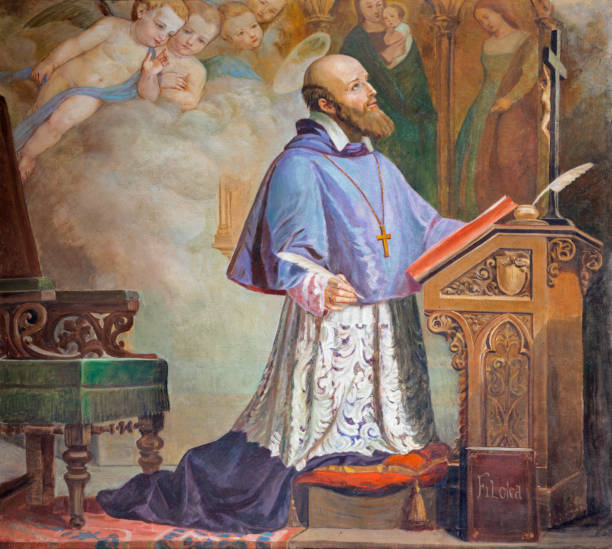
From St. Francis de Sales’ Introduction to the Devout Life
Translated by John K. Ryan, published by Image, an imprint of the Crown Publishing Group,
Random House LLC, New York 1966
“Since the true means to attain to love of God is consideration of his benefits, as the great Angelic Doctor states, the more we know about them the more we shall love him. [ . . . ] Certainly nothing can so effectively humble us before God’s mercy as the multitude of his benefits and nothing can so deeply humble us before his justice as our countless offenses against him” (123-124).
“What good do we possess that we have not received?” (124).
“Thus the Blessed Virgin proclaims that god has done great things for her, but she does so only to humble herself and to glorify God. ‘My soul magnifies the Lord, because he has done great things for me,’ she says” (124).
“True humility does not make a show of itself and hardly speaks in a humble way. It not only wants to conceal all other virtues but most of all it wants to conceal itself” (124-25).
“My advice then, Philothea, is for us not to speak words expressing humility or else to speak them with a sincere interior feeling in keeping with what we utter outwardly. Let’s not lower our eyes except when we humble our hearts” (125).
“However, I would truly like our words always to be suited as closely as possible to what we feel, so that in all things and through all things we may maintain heartfelt sincerity and candor. A truly humble man prefers that another tell him that he is a sorry fellow, that he is nothing at all and that he is worth nothing, than to say it himself” (125).
“Others refuse to use their talents in the service of God and their neighbors because, they say, they know their weakness and fear they’ll become proud if they are instruments of any good and that by giving light to others they would be consumed. All this is merely artifice and a form of humility that is not only false but even malicious” (126).
“Does he not see that when God desires to give us his graces, it is pride to refuse them, that God’s gifts obligate us to accept them, and that it is humility to obey and comply as nearly as we can with his desires? It is God’s will that we become perfect by uniting ourselves to him and imitating him as closely as possible” (126).
“The proud man who trusts in himself has good reason not to attempt anything. The humble man is all the more courageous because he recognizes his own impotence” (126).
“Humility conceals and covers over virtues in order to preserve them, but it reveals them when charity so requires in order that we may enlarge, increase, and perfect them” (127).“In like manner humility covers over and hides all our purely human virtues and perfections and never displays them except for the sake of charity. Since charity is not a natural but supernatural and not a moral but a theological virtue, it is the true sun of all the virtues and should have dominion over them” (127).
“Yet humility agrees with the counsel of the Wise Man who warns us to ‘take care of our good name,’ because to esteem our good name is not to esteem an excellence but only honesty and integrity of life” (131).
“The root of a good name is virtue and probity” (133).
“Let us always keep our eyes fixed on Jesus Christ crucified and go forward in his service with confidence and sincerity but with prudence and discretion. He will protect our reputation. [ . . . ] By surrendering our reputation together with our soul into God’s hands, we safeguard it in the best way possible” (134).
“’Learn of me, he says, ‘for I am meek and humble of heart.’ Humility perfects us with respect to God, and meekness with respect to our neighbor” (134).“Our Saviour has instituted the most august sacrament of the Eucharist, which contains his flesh and blood in their reality, so that whoever eats of it shall live forever. Therefore whoever turns to it frequently and devoutly so effectively builds up his soul’s health that it is almost impossible for him to be poisoned by evil affection of any kind” (104).
“Begin your preparation for Holy Communion on the evening before by many loving aspirations and transports and retire a little earlier so that you may rise earlier in the morning. ( . . . . ) In the morning get up with great joy because of the happiness you hope for” (107).
“After you have received him, excite your heart to do homage to the King of salvation. Converse with him concerning your inmost concerns. Reflect that he is within you and has come there for your happiness” (107).
“Your great intention in receiving Communion should be to advance, strengthen, and comfort yourself in the love of God ( . . . . ) No, you cannot consider our Savior in an action more full of love than this. In it he abases himself, if we may so express it, and changes himself into food, so that he may penetrate our souls and unite himself most intimately to the heart and body of his faithful” (108).
“Go often to Communion, Philothea ( . . . .) so by adoring and eating beauty, purity, and goodness itself in this divine sacrament you will become wholly beautiful, wholly good, and wholly pure” (109).


